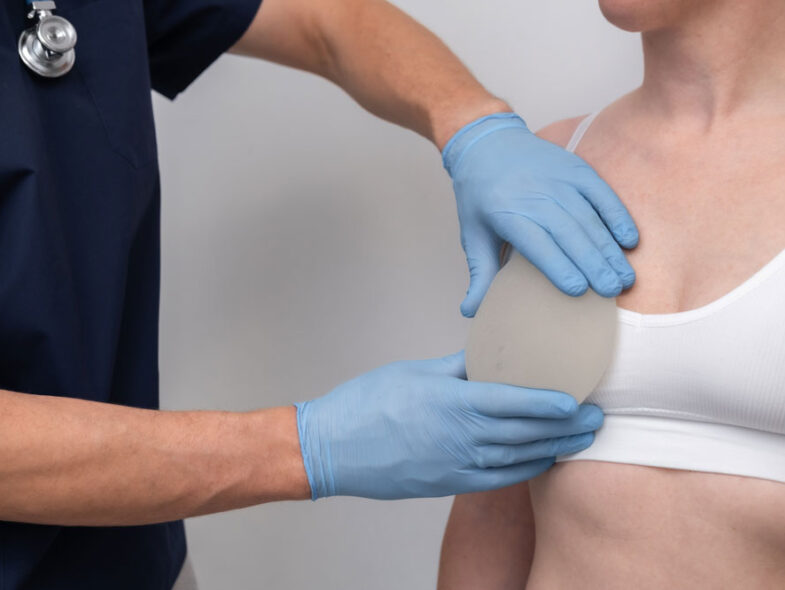
Women consider breast revision surgery in San Diego for numerous reasons. Understanding these various motivations can help you determine whether revision might be appropriate for your situation.
Capsular Contracture
One of the most common complications requiring revision is capsular contracture. After breast augmentation, your body naturally forms a thin layer of scar tissue (the “capsule”) around the implant. In some cases, this capsule thickens and tightens, causing the breast to feel unnaturally firm or hard. Severe capsular contracture can distort breast shape, create visible deformities and cause significant discomfort. Revision surgery removes the thickened capsule and often involves replacing the implants to restore a softer, more natural feel.
Changing Implant Size
Your aesthetic preferences may evolve over time. Some women find that their implants feel too large after years of living with them, particularly if lifestyle changes or weight changes have altered their body proportions. Others discover they want more volume than their current implants provide. Breast augmentation revision allows you to exchange your current implants for a size that better aligns with your current goals for your appearance.
Switching Implant Types
Advancements in implant technology mean newer options may offer benefits over older implant types. Some patients choose revision to switch from saline to silicone implants for a more natural feel or to decrease rippling. At times, as patients age, they may prefer the long-term safety benefits of saline implants.
Implant Rupture or Deflation
Saline implant deflations are usually easy to detect. The saline leaks out and the implant deflates, creating visible asymmetry. Early silicone implant ruptures are more difficult to detect because the cohesive gel typically remains within the implant shell or within the surrounding capsule. Regular monitoring with ultrasound or MRI helps identify “silent” ruptures. When rupture is present, revision surgery removes the damaged implant and the gel contents.
Implant Malposition
Implants can shift from their original position over time. Bottoming out occurs when an implant descends too low on the chest wall, which creates an unnatural appearance with the nipple pointing more upward rather than forward. Lateral displacement happens when implants move toward the sides of the chest, toward the armpit area. Symmastia develops when implants positioned too close together create a “uniboob” appearance. Revision surgery repositions the implants and involves modifying or adjusting the breast pocket to prevent recurrence.
Double Bubble Deformity
A double bubble creates the appearance of a two-tiered breast with a visible line separating the implant from the natural breast tissue. This deformity can result from an implant sitting below the natural breast fold or from inadequate release of the inframammary fold during the initial surgery. Correction requires precise adjustment of the breast pocket and fold position.
Visible Rippling or Wrinkling
Rippling appears as visible waves or wrinkles in the breast contour, most commonly seen in patients with thin breast tissue or insufficient soft tissue coverage over the implants. This issue occurs more frequently with saline implants and with subglandular (over the muscle) placement. Revision can address rippling by switching to silicone implants, changing the placement from over to under the muscle and/or adding tissue coverage through fat grafting or placement of a mesh.
Changes in Breast Tissue
Your breasts can continue to change throughout your life. Pregnancy and breastfeeding can stretch breast skin and alter its elasticity. They can also lead to atrophy or involution of the natural breast tissue. Significant weight fluctuations can also affect the amount of natural breast tissue. These changes may create the need for revision surgery to maintain aesthetic results, sometimes combined with a breast lift (mastopexy) to address sagging or excess skin.
Desire for Implant Removal
Some breast augmentation patients choose to remove their implants altogether. Their reasons may involve concerns about their health, changes in lifestyle or fitness activities, evolving aesthetic preferences, or simply feeling ready to return to their natural breast size. Breast implant removal (explant) can be performed alone or combined with other procedures like fat transfer or breast lift to optimize the final breast contour.